


Strategic Coaching for private healthcare
A practice that runs well without every decision coming back to you.
Practice growth and exit planning for principals of dental, surgical and specialist practices, from the author of The Exit Discipline. Whether you came looking for dental practice coaching or a plan to sell in five years, the work starts in the same place: the decisions that still depend on you.
The 90-Day Practice Programme works through them with a practice lead you nominate, in three gated phases, and leaves your team with tools and routines it keeps using.
Led by Gregory Gray. Built on The Exit Discipline. Your time kept deliberately small.
From the quote nobody followed up to the decision that waits for your return, we help practice principals build a business that runs on systems rather than on them – stronger to own today, and ready to be examined whenever someone asks.
From The Exit Discipline
Do you know what a new patient costs you?
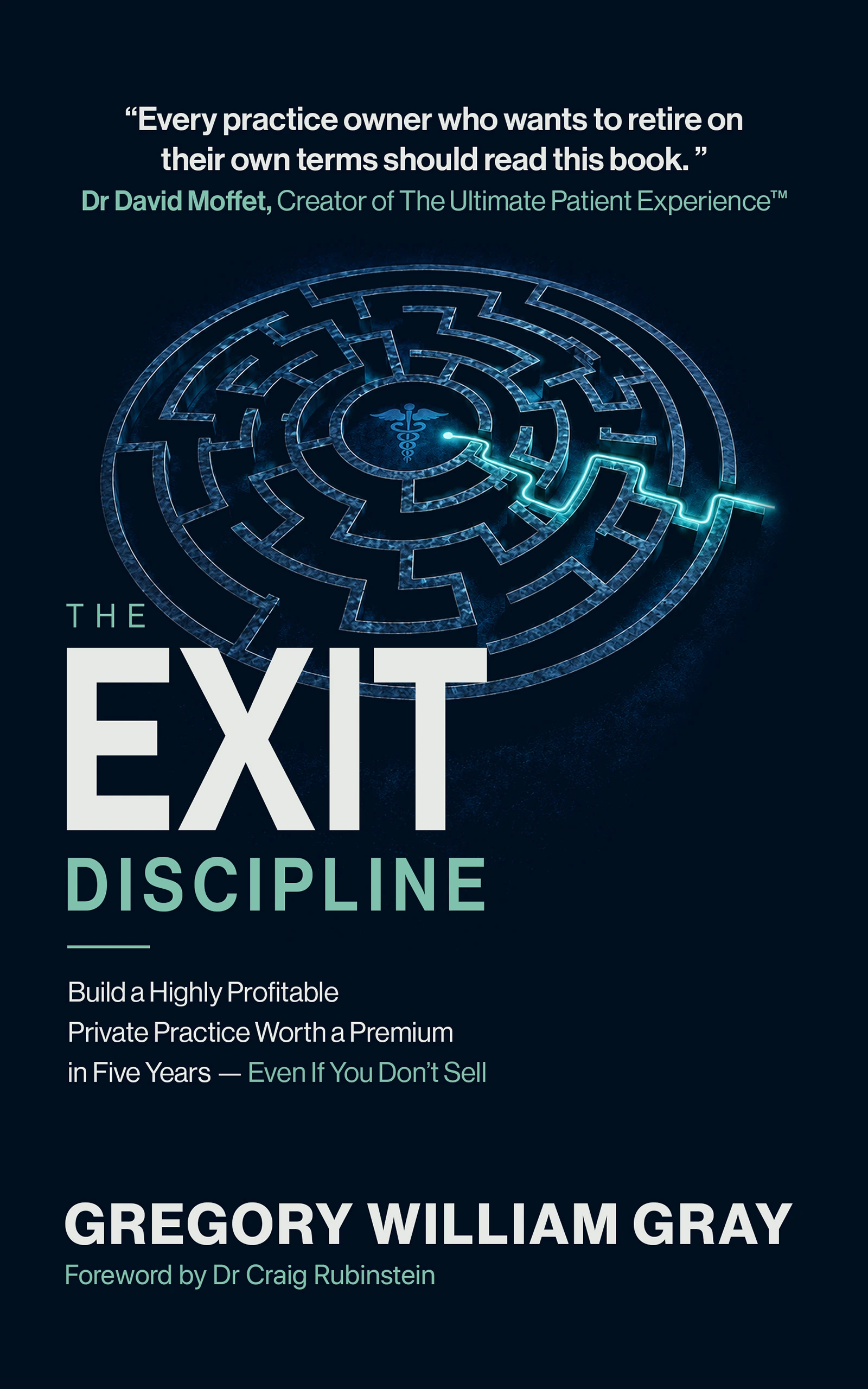
In The Exit Discipline, Gregory Gray describes a three-site UK dental group that knew its cost per acquisition by channel. Few principals do, and a buyer’s adviser will ask. Numbers like these belong on an owner scorecard.
- Cost per acquisition, Google Ads
- £310
- Cost per acquisition, Meta
- £740
- Cost per acquisition, organic search, approximately
- £60
A three-site UK dental group, as described in The Exit Discipline by Gregory William Gray. One group’s figures, shown as an example rather than a benchmark.
What the practice keeps
Tools your team keeps using long after the programme ends.
The 90-Day Practice Programme
Three gated phases, with your team doing the work.
Each phase ends at a gate, where you review what has been done and decide whether the work moves on, changes or stops. A short weekly huddle chaired by your practice lead, and a weekly note with the few decisions needed from you, keep it moving. Dates are set in the written scope and can move with the practice’s calendar.
Before we begin
Start with the questions
Begin, if you like, with the written exit-readiness self-assessment, then talk it over with Gregory. Scope, fees and timing are agreed in writing before any work begins.
Phase one
Review
Establish the starting position, the priorities and who can make which decisions. The phase ends with an agreed picture of what will be built and tested.
Phase two
Build and test
Develop the agreed tools and routines with the people who will use them, and try them in the practice’s real work.
Phase three
Hand over
Review live use where authorised, train the team and agree what needs attention next. The practice keeps the tools and the instructions to run them.
Afterwards
Keep the rhythm
The weekly huddle stays with your practice lead. If you would like someone to keep asking the harder questions, a continuing owner’s review can be agreed separately.
Who it’s for
For principals who lead the clinic and the business at once.
Dental Practices: Dental practice coaching for owners who want their evenings back.
Treatment-coordination handoffs, follow-up of undecided treatment plans, session capacity and an owner scorecard, so the practice runs on systems rather than on you.
Explore dental practicesPlastic Surgery: For surgeons whose practice runs through one name.
Coordinator workflow, quote administration, theatre readiness and referral concentration: the parts of a surgical practice a buyer or partner examines first.
Explore plastic surgery practicesDermatology: For dermatologists growing a cosmetic list beside a medical one.
Referral continuity, service-line capacity and clear decision rights for a team that handles clinical and cosmetic work side by side.
Explore dermatology practicesOphthalmology: For eye clinics adding surgeons, sites or services.
The capacity, staffing and cost questions to settle before fixed commitments are added, and the management information to see whether a change is working.
Explore ophthalmology practicesConcierge Medicine: For private GPs whose patients ask for them by name.
Membership continuity, cover arrangements and patient handover, so the service patients value does not depend on one doctor always being available.
Explore concierge medicinePractice Groups: For groups that want one standard across every site.
Enquiry routing, service-line capacity, team escalation and management information across sites, so the group runs to a standard rather than on a few people.
Explore practice groups


Get your practice valued
What is your practice really worth?
Coaching works on how the practice runs. A valuation shows what it is worth today, and how much of that value a buyer would see resting on you. Before you plan what comes next, whether a partner, a sale or simply a stronger practice, find out what a buyer would see.
- IndependentA buyer’s-eye view of your practice, with no transaction to sell you
- ConfidentialNo obligation, and no pressure to sell
What you’ll leave knowing
What a buyer will examine:
Maintainable earnings, clean accounts with agreed adjustments, current agreements and the evidence behind your income.
How much depends on you:
Which parts of the practice rely on your own list, your own referrers and your own evenings, and which already run on systems a buyer can see.
Why patient acquisition is priced:
What a new patient costs by channel, and a documented record of how patients find and contact the practice.
What to gather first:
Three years of accounts, the lease, your team structure and your enquiry record.
Where it begins
A private conversation with Gregory Gray about your practice and what you want to know. Then a full valuation with advisers from investment banking and law, its scope agreed with you before any work begins.
The next step is a conversation, not a commitment.
CareConcierge FAQs
How would coaching fit the practice you own?
The questions principals ask before they begin, with the detail behind each answer.

What does strategic coaching cover?
The operational decisions that keep a practice dependent on its owner. You choose the issues that need attention, and the written scope sets out which of these the programme covers.
People and workflow
Responsibilities, routine decision rights, quote or treatment-coordination administration, cover arrangements and a short weekly management rhythm.
Patient and referral continuity
Where enquiries and referrals arrive, what happens next, who follows up and where a small number of sources create dependence.
Capacity and service economics
The rooms, chairs, sessions, staffing or theatre capacity behind a proposed change, and the cost questions to settle before fixed commitments are added.
Owner information and repeatable systems
A practical scorecard, documented pathways, operating knowledge and the next set of commercial decisions.
Will the practice be different in 90 days?
The programme is planned in three phases over about a quarter, and dates can move with the practice’s calendar. What it delivers is the agreed tools and routines, built, tested and handed over. How they change the practice depends on how they are used.
Testing a tool, training the team and seeing results in live use are reported separately, and none of them on its own shows a financial improvement. You will always know which is which.
How much of my time does it take?
As little as practical. Most of the work happens with the practice lead you nominate and the team, and the time needed from you is set out in the written scope.
A weekly huddle
A short meeting chaired by your practice lead, so the work belongs to the practice from the start.
A weekly note
Progress and the few decisions needed from you that week, in writing.
Phase gates
A review at the end of each phase, where you decide how the work proceeds.
Your information, on your terms
Access only to the information the practice authorises.
Who will I work with?
Strategic coaching is led personally by Gregory Gray, author of The Exit Discipline, working with a practice lead you nominate. The contracting party, scope and fees are set out in a written engagement letter before any work begins.
Gregory brings almost thirty years in branding, digital transformation and private healthcare marketing, and has built, scaled and sold three agency businesses. He wrote The Exit Discipline for principals who want a practice worth a premium in five years, even if they never sell.
Is a full programme the only option?
No. We agree which fits after an initial conversation, and you can start small.
Choose a starting point
How it would work
For a single question, such as a new service, a partner or a change of premises, a focused advisory brief may suit better than a programme.
- Tell us the decision in front of you
- Agree what the brief will answer
- Receive a written view you can act on
How it would work
The 90-Day Practice Programme, for principals who want help doing the work: choosing the issues, building the tools with the team and handing them over.
- Choose the issues with Gregory
- Agree the written scope
- Three gated phases, then the handover
How it would work
After a programme, a continuing owner’s review can be agreed separately, to keep the scorecard honest and the next decisions moving.
- Agree how often you meet
- Review the scorecard together
- Decide the next priorities
Is this clinical, legal or financial advice?
No. Strategic coaching is management coaching: it works on operational decisions, routines and management information, and hands over materials the practice keeps.
Clinical decisions
Clinical suitability, treatment recommendations, prescribing and consent stay with your clinicians.
Professional advice
Legal, tax, employment, accounting and regulated financial advice stay with your own qualified advisers.
Other services
The AI Conversion Platform and marketing services are scoped separately where relevant. The programme stands on its own, and you need neither.
Will coaching increase what my practice is worth?
No change in practice value is promised. What the work can do is make the practice easier to examine: decisions that no longer depend on you, routines your team runs and numbers you can show rather than describe.
A buyer, a partner or a lender is likely to ask how the practice runs when the owner is not in the room. The exit-readiness self-assessment shows where your answer is weakest, and a practice valuation shows what a buyer would see today.
How do we start?
Book a conversation, or send a programme enquiry. You can begin with the exit-readiness self-assessment, so the conversation starts from what you already know.
- Self-assessmentWork through the written exit-readiness questions with your practice manager.
- ConversationThirty minutes on what is taking too much of your time or proving difficult to change.
- Written scopeScope, fees and timing agreed in writing before any work begins.

Gregory Gray with Dr David Moffet
A full diary can conceal an unfinished business.
The implant enquiry that cooled. The treatment plan nobody followed up. The decisions that still come back to you. A practice can look busy while its commercial systems leave the principal carrying the gaps.
In Episode 116 of The Ultimate Dental Podcast, Dr David Moffet and Gregory Gray discuss patient intent, the five levers of profitability and what it takes to build a practice with value beyond the owner’s own clinical hours.
Episode 116 · The Five Levers of Dental Practice Profitability


Discuss your practice
A strategy conversation with someone who understands practice growth and exit planning.
Thirty minutes on what is taking too much of your time, what you would want a buyer to see and how much of the practice still depends on you. You’ll leave with a clear view of where to start, whether or not we work together.
- Australia+61 2 9127 9005
- United Kingdom+44 20 7011 8509